
Hands up if you have ever thought about quitting your job to travel the world? Obviously, this would have been a pre-pandemic thought. But despite being in the middle of a pandemic, workers in the developed world have been leaving their jobs in droves. This phenomenon has been termed ‘The Great Resignation’ and in some circles, ‘The Great Realisation’.
Some have even taken this a step further, deciding on a career break. The time gained can then be spent on further education or training, with family, tackling items on a to-do list or just taking it easy. The career break movement is gathering pace online.
The online commentary
Job dissatisfaction and burnout are surfacing on platforms such as LinkedIn. LinkedIn is known as one of the more professionally-oriented social media platforms. Showing vulnerability is normally not the done thing on LinkedIn, yet posts on burnout and the importance of happiness at work can go viral.
This LinkedIn post on burnout has attracted more than 50,000 reactions (at the time of writing this). The number of reactions demonstrates that such a topic has support. Those reacting may even feel a sense of solidarity with the post’s message. The post continues to be popular to this day as new users discover it and are compelled to share it within their network. I often think that such acts may even be sending a message to all the bosses out there.
The medium of blogging has enticed many a career breaker to share their experience with the wider world. A quick search for the term ‘career break’ on WordPress, a popular blogging platform, reveals blogs devoted to the topic.
Examples of blogs that I came across include a teacher who left her job to pursue travel (pre-pandemic) and an office worker who has taken a year off work to return to study, among other things. Notice that these are examples of ordinary people taking career breaks. With the appropriate preparation and mindset, it is possible!
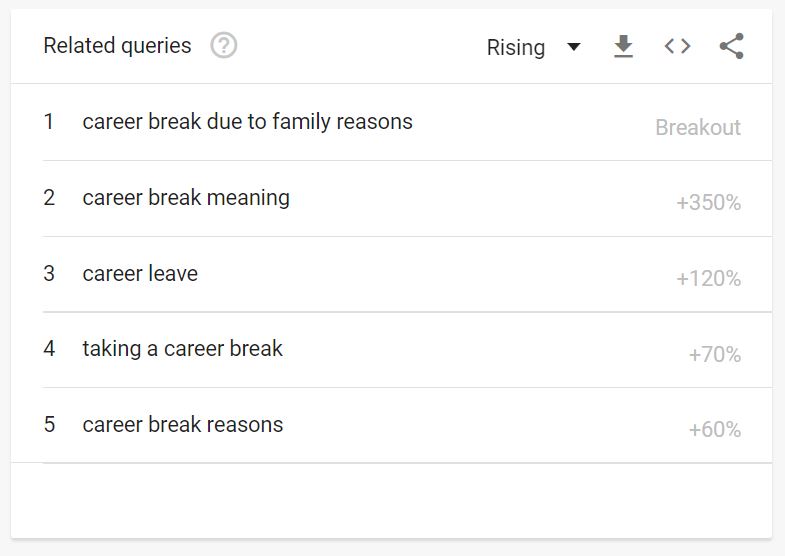
Further indication that there is real online interest in career breaks can be seen via Google Trends. As per the table below, ‘career break’ as a search engine topic has experienced strong growth worldwide over the past 5 years. Moreover, the search string ‘career break due to family reasons’ in particular, has become a more commonly used, related search term.
Now, let’s dial things up a few notches
Earlier this year in China, an online post about tang ping which translates into English as ‘lying flat’, went viral. The premise of the lying flat movement is to shun demanding and high-stress jobs, to not aspire for great material wealth (including a house and car), to not get married or have children, and to live a more laid back and simple lifestyle. Want to know more about lying flat? Check out the short video below.
The Chinese government is reportedly concerned with the lying flat movement. An argument that has been put forth is that China’s continued growth and future prosperity rest in the hands of the labour force. If workers decide to all start ‘lying flat’, then China’s future is in jeopardy.
Some people may join the lying flat bandwagon. But I suspect that most people won’t due to the movement being quite restrictive. Plus, people like nice things and nice things cost money.
Lying flat could almost be seen as a permanent or more extreme career break. From that perspective, an ordinary career break doesn’t seem like such a radical idea anymore, does it?
Some considerations if you are thinking about a career break
Career breaks come in all shapes and sizes. It could be for 3 months to 1 year, and sometimes longer. Some people get permission from their employer to take a leave of absence. Others choose to make a clean break by quitting their job outright. Career breaks are similar to sabbaticals, but the former is a more general term and applicable to most roles and industries.
One of the most important considerations when taking a career break is finances. I hate to dampen the mood by talking about money, but it would be irresponsible for me to not mention it.
You will need to factor in your living expenses, the cost of any travel or education you plan to undertake, and a contingency fund should any unexpected expenses arise. If you don’t have a job to come back to, you will need to also factor in that it may take a few months or more to find a new job when you are ready to start looking for work.
In Australia, permanent staff are entitled to 3 months of paid long service leave once they have completed 10 years of service at a company. Elsewhere, there are companies that offer their own in-house leave entitlements for meeting various years of service. In an era where it is increasingly difficult to stay with one company, many workers are taking matters into their own hands by deciding to take a career break when it suits them.
Deciding to take a career break is usually a very difficult and emotional decision, especially when resignation is involved. But when the reasons for taking a career break are abundantly clear, you will find the confidence to go ahead, realising that it’s a risk worth taking.

 Careers, Personal Development and More