When I was younger, I used to hear about self-help books on TV. My naïve perception was they were for desperate people. As I’ve gotten older, my reading habits have moved away from novels and fiction, and into the realm of psychology, philosophy and business. In other words, I’ve become a fan of self-help. Moreover, I can’t get enough of it.
With the rise of the internet and all things digital, the definition of self-help has broadened. Enter personal development. Think TED talks and e-learning platforms such as LinkedIn Learning. TED talks on topics such as procrastination and reducing waste have had millions of views on YouTube. In this article, we explore some of the tension surrounding self-help and personal development in the 21st century.
There is shame/stigma associated with self-help
For the past few months, I’ve been taking a university subject on book marketing. My interest was piqued when it was mentioned that in recent times, self-help books have become popular as e-books. No explanation was given during the lecture, but the prevailing theory regarding the discreteness of e-books (i.e. it’s harder for people to tell what you’re reading because they can’t see the cover) may apply.

Are people generally embarrassed to admit that they work on their personal development?
I recently conducted a poll on LinkedIn regarding people’s preferred personal development tool (see image below). The four options to choose from were: books, TED talks, LinkedIn Learning and courses organised by your workplace.
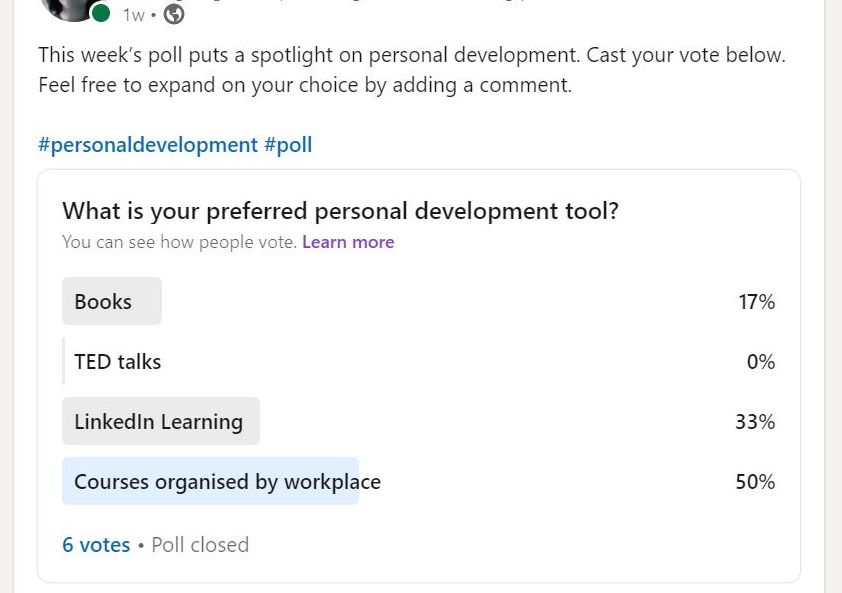
Considering the number of votes received for this poll topic compared to the other polls I have run, this topic ranked 4th out of 6 polls. Such a ranking may suggest a hesitancy to admit publicly to engaging in personal development.
Professor Beth Blum was interviewed by NBC News and suggested “that the self-help impulse … isn’t just confined to self-help books. It’s everywhere. That makes self-help seem a lot more normal and natural.”
Therefore, there is no need to be embarrassed to admit that you read self-help or work on your personal development. We are all works in progress. There will inevitably be ups and downs in life, and self-help and personal development will always be there as a resource.
Self-help and personal development are more accessible than ever
“Self-help gurus have moved … into app territory in order to expand their audience while giving the appearance of a one-to-one experience” wrote Julian Vigo. Many e-learning programs have been designed to work on different operating systems and different devices. While TED talks are freely available on YouTube.
However popular TED talks are, they still have their critics. Julie Bindel wrote in The Guardian, “The talks are so rehearsed that even the well-placed pauses and casual hair flicks look hideously false.”
Bindel makes an interesting point and we’ve all heard how important body language is for verbal communication. However, it seems that the majority of people are able to look beyond the image or portrayal. Focusing instead on the message that is at the heart of the TED talk. Perhaps that’s the power of the TED name.
Let’s end with some recommendations. In terms of books, I enjoyed Outliers by Malcolm Gladwell and How to stop worrying and start living by Dale Carnegie. There are so many great courses on LinkedIn Learning, but one that really impressed me was Powerless to powerful: taking control by Fred Kofman.
Over to you. What courses, videos/talks or books would you recommend to others? Leave a comment below.

 Careers, Personal Development and More